books
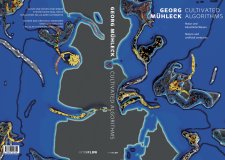
GEORG MÜHLECK — "CULTIVATED ALGORITHMS"
Natur und künstliche Wesen / Nature and artificial creatures
Published by ARTINFLOW Verlag Berlin
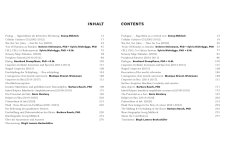
24 x 34 cm, German / English, Hardcover, 280 Pages, 220 images
Published in February 2026, ISBN: 978-3-938457-74-0
Authors:
Georg Mühleck, Monique Brunet-Weinmann, Sylvia Niebrügge,
Boris Nieslony, Barbara Rauch, Dolores Steinmann,
Bernhard Stumpfhaus
€38,00 incl. 7% VAT + shipping / Versand
€70,00 + shipping / Versand: Mit Originaldruck A4 auf Canson
edition etching 310g; stets verschiedene Motive ohne Wahl;
rückseitig betitelt, mit Stempel und Prägung / with 1 Original print






or / oder Bank Transfer: Bitte Email senden / Please send email for IBAN: mail(at)georgmuehleck.com
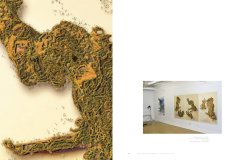
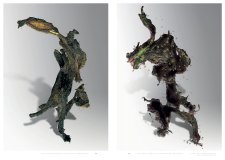
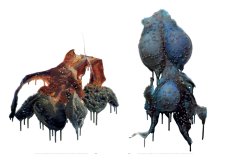
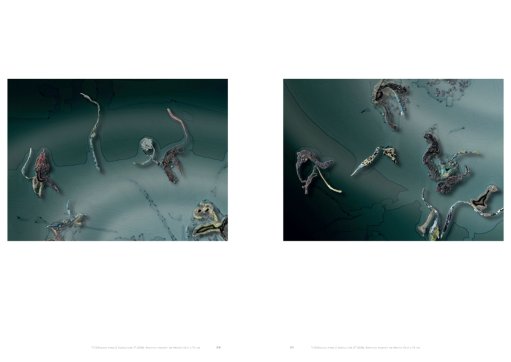
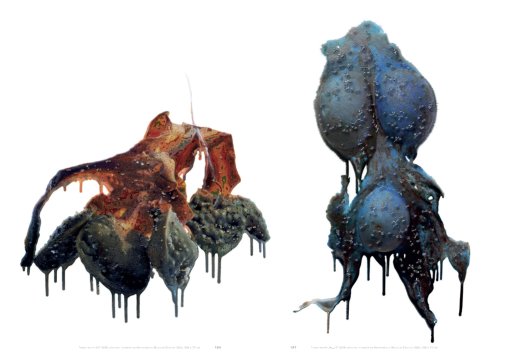
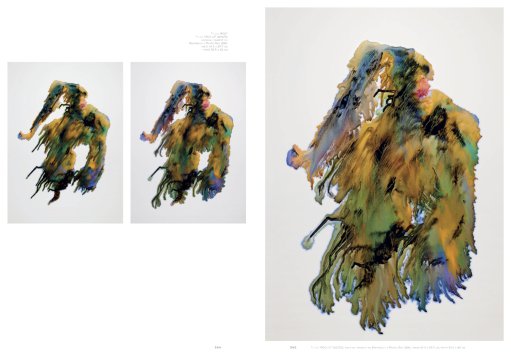
Georg Mühlecks „Cultivated Algorithms“ reflektiert die rasanten Veränderungen durch Wissenschaft und Digitalisierung, thematisiert insbesondere das Spannungsfeld zwischen Biologie und Mathematik, Natur und Technik, Evolution und möglicher Zerstörung. Im Zentrum steht die künstlerische Auseinandersetzung mit Algorithmen und künstlich generierten, biologisch-synthetischen Formen, die als Metaphern für wissenschaftliche Prozesse dienen. Gleichzeitig äußert der Künstler Skepsis gegenüber aktueller KI in Kunst und Kreativität. Werke wie „Cellular Cultures (T)“ verbinden Georg Mühlecks frühere Arbeiten über Gehirn und Erinnerung. Ausgangspunkt sind algorithmisch gesteuerte Zellformationen, die sich über viele Generationen entwickeln und schließlich zu einem fremdartig wirkenden Kunstgebilde erstarren. Diese Formen stellen keine reale Natur nach, sondern deuten unbekannte Wesen an.
Ulrike Oppelt, ARTINFLOW Verlag Berlin, https://www.artinflow.de
Georg Mühleck's ‘Cultivated Algorithms’ reflects on the rapid changes brought about by science and digitalization, focusing in particular on the tension between biology and mathematics, nature and technology, evolution and potential destruction. At its heart is an artistic exploration of algorithms and artificially generated, biologically synthetic forms that serve as metaphors for scientific processes. At the same time, the artist expresses skepticism about current AI in art and creativity. Works such as ‘Cellular Cultures (T)’ connect Georg Mühleck's earlier works on the brain and memory. The starting point is algorithmically controlled cell formations that develop over many generations and eventually solidify into strange-looking artificial structures. These forms do not imitate real nature but suggest unknown beings.
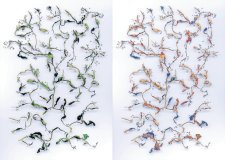
Georg Mühleck beschäftigt sich seit 1992 mit zellulären Automaten und nutzt sie als Denkmodell für biologische und geistige Prozesse. Parallel dazu reflektiert er über Subjektives, wie Erinnerung und Wahrnehmung als etwas, das durch körperliche und chemische Einflüsse, symbolisch am Beispiel von Tee, beeinflusst wird. Der Künstler sammelt, sortiert und arrangiert Teeblätter wie Zeichen oder Neuronen eines Netzwerks. Inspiriert von Erkenntnissen der Hirnforschung versteht er sein Kunstwerk als Landkarte eines Denkprozesses, das geistige Aktivität und Fantasie sichtbar machen soll.
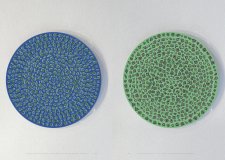
Inhaltlich beschäftigt er sich auch mit der Frage, wie sich Leben bzw. Bewegung in ein eigentlich statisches, zweidimensionales Bild aus zellulären Automaten bringen lässt. Verglichen mit historisch-künstlerischen Illusionen wie der Perspektive in der Renaissance oder den Wahrnehmungstäuschungen der Op Art entsteht illusorische Bewegung nicht im Bild selbst, sondern durch die Art, wie unsere Augen und unser Gehirn visuelle Informationen verarbeiten. Für einige seiner Arbeiten nutzt der Künstler Formen aus mikroskopischen Zellkulturen, die sich beim Betrachten zu bewegen scheinen, tatsächlich bewegen sich jedoch die Augen der Betrachtenden.
Ein zellulärer Automat ist ein Computermodell aus einem regelmäßigen Raster gleichartiger Zellen. Jede Zelle besitzt einen bestimmten Zustand und ändert diesen nach festgelegten Regeln in Abhängigkeit von ihren Nachbarzellen. Obwohl die Regeln einfach sind, können durch ihr Zusammenspiel komplexe Strukturen und Prozesse entstehen. Das Konzept wurde Ende der 1950er-Jahre von den Mathematikern Stanislaw Ulam und John von Neumann entwickelt. Von Neumann war besonders daran interessiert, ein System zu schaffen, das sich selbst reproduzieren kann, also grundlegende Eigenschaften von Leben nachahmt. Heute werden zelluläre Automaten in vielen Wissenschaften genutzt, z. B. in der Biologie, Physik, Informatik und Astrophysik. —
********
Georg Mühleck has been working with cellular automata since 1992, using them as a conceptual model for biological and mental processes. At the same time, he reflects on subjective phenomena such as memory and perception as something that is influenced by physical and chemical factors, symbolically illustrated by the example of tea. The artist collects, sorts, and arranges tea leaves like symbols or neurons in a network. Inspired by findings in brain research, he understands his artwork as a map of a thought process that aims to make mental activity and imagination visible.
In terms of content, he also deals with the question of how life or movement can be brought into an essentially static, two-dimensional image of cellular automata. Compared to historical artistic illusions such as Renaissance perspective or the perceptual illusions of Op Art, illusory movement does not arise in the image itself, but rather through the way our eyes and brain process visual information. For some his works, the artist uses forms from microscopic cell cultures that appear to move when viewed, but in fact it is the eyes of the viewer that are moving.
A cellular automaton is a computer model consisting of a regular grid of identical cells. Each cell has a specific state and changes this state according to defined rules depending on its neighboring cells. Although the rules are simple, their interaction can give rise to complex structures and processes. The concept was developed in the late 1950s by mathematicians Stanislaw Ulam and John von Neumann. Von Neumann was particularly interested in creating a system that could reproduce itself, i.e., mimic the basic properties of life. Today, cellular automata are used in many sciences, e.g., biology, physics, computer science, and astrophysics. — Ulrike Oppelt, ARTINFLOW Verlag Berlin
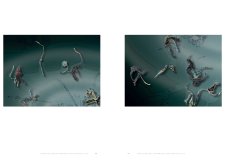
Sample Pages: